Launch offer — valid today only

📄 Digital book in PDF · read it on your phone or print it

Home Generator Sizing, Safety and Winter Care in Drawings One Topic on Every Page

Your load list, running and starting watts, the well pump and sump pump, the right distance outdoors, carbon monoxide, backfeed, start-up, refuelling and winter storage. Every topic gets its own page: the drawing first, then what you need to remember. 69 illustrated pages.

GET MY ILLUSTRATED GENERATOR PLAN

🔒 Secure checkout · PDF by email · 30-day guarantee

Every topic, its own pageEach routine and rule drawn, with the explanation beside it
69 illustrated pages9 parts, from how a generator works to the pre-storm checklist
Up-to-date sourcesChecked against the Canadian Electrical Code, Health Canada's CO guidance and manufacturers' manuals
PDF by emailFormat

Look Inside the Book

Every page has one big drawing and a box with the watts, distances and steps you need to know:

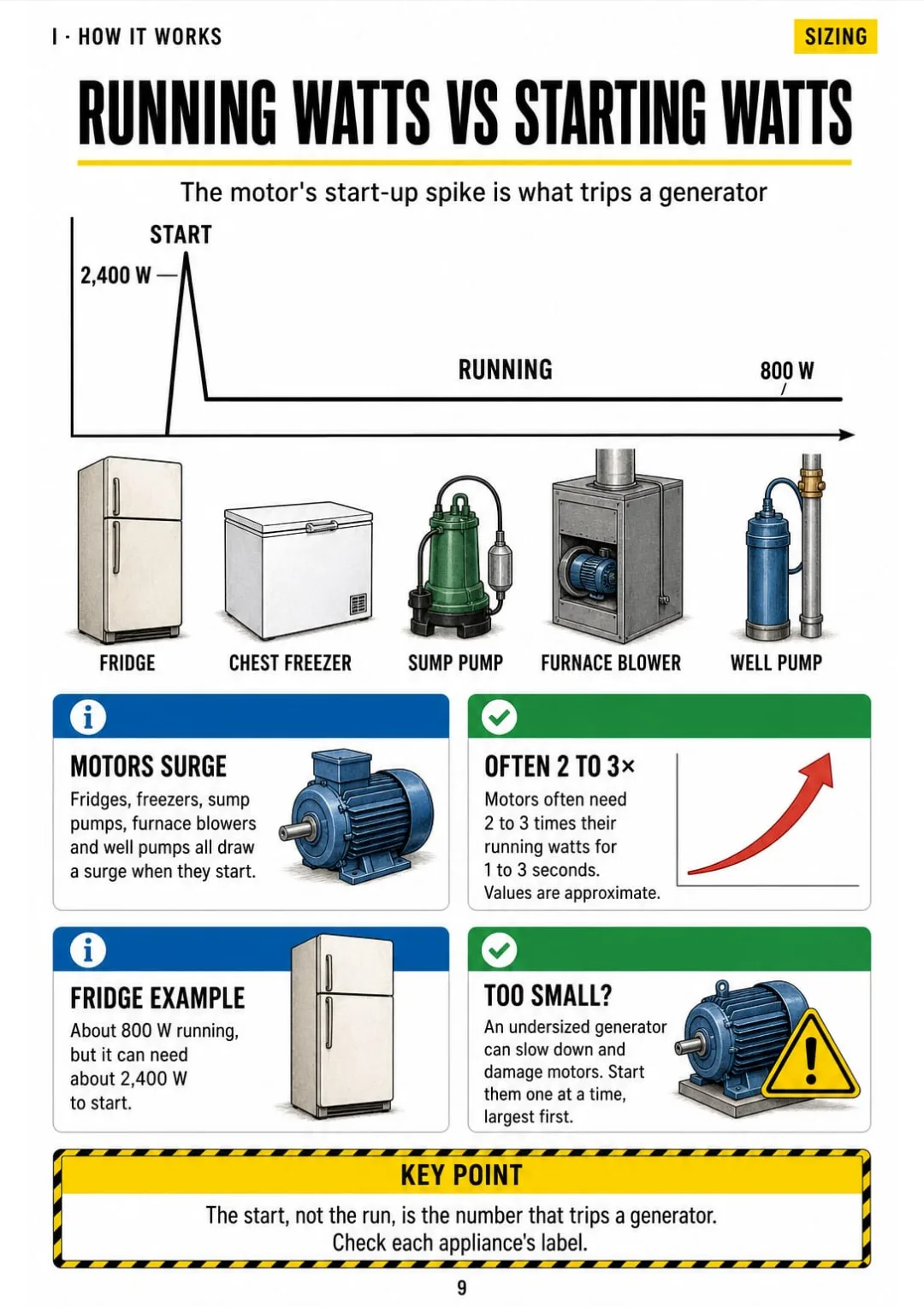
Motors often need 2 to 3× running watts to start: fridge ~800 W run, ~2,400 W start
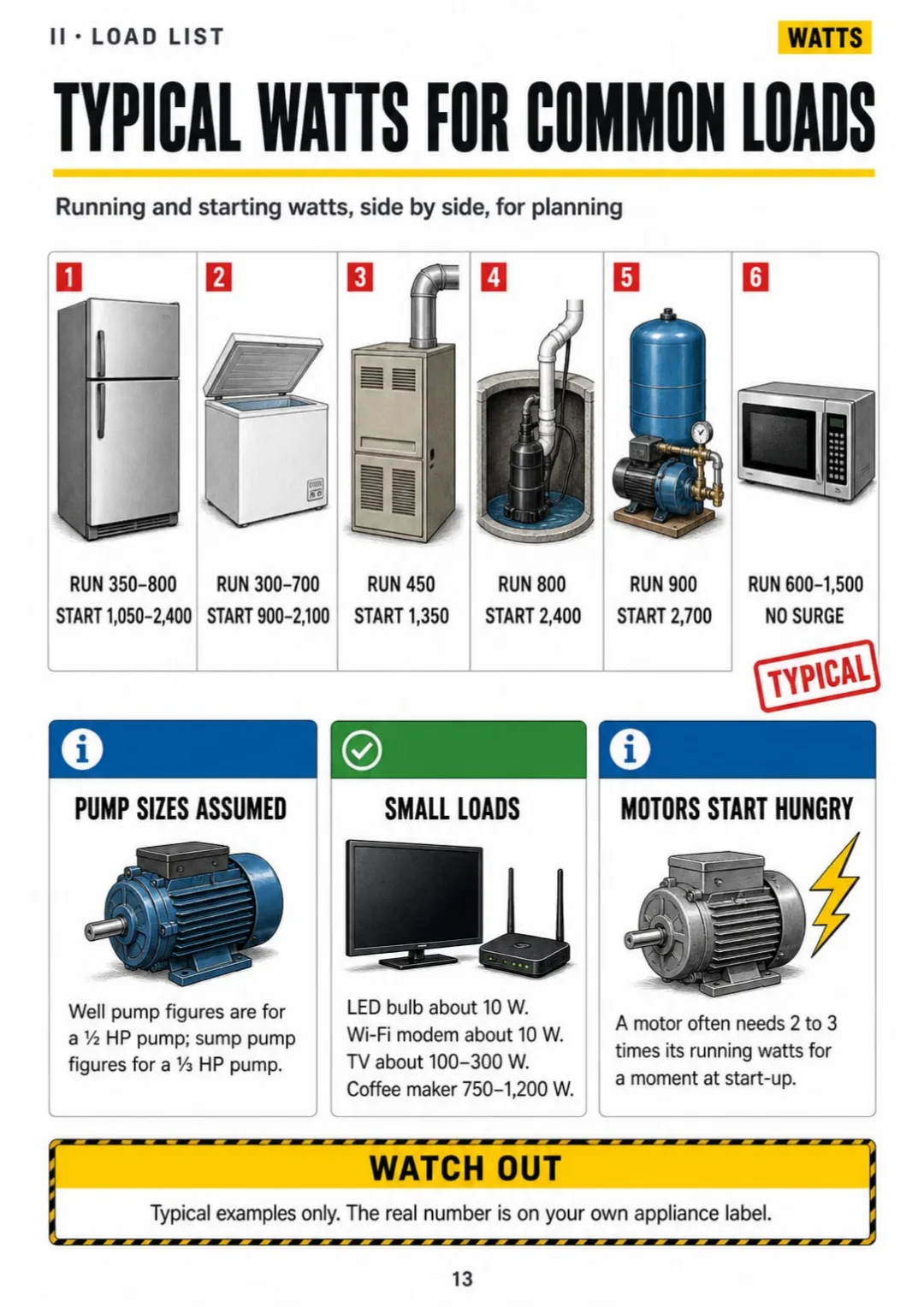
Fridge: about 350–800 W running, up to 2,400 W to start. Typical figures, check your labels.
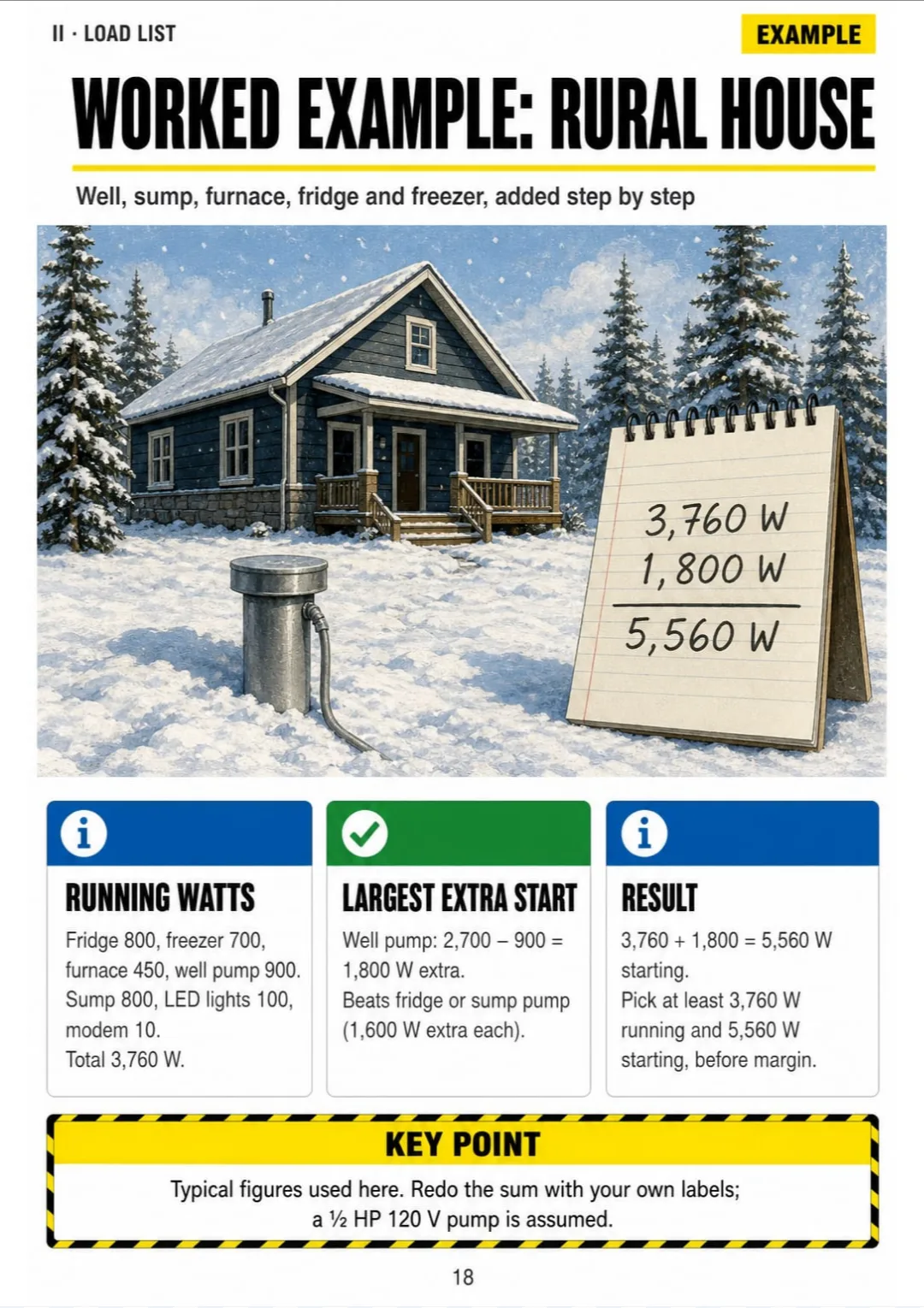
Rural house with well: 3,760 W running + 1,800 W pump start = 5,560 W starting watts needed.
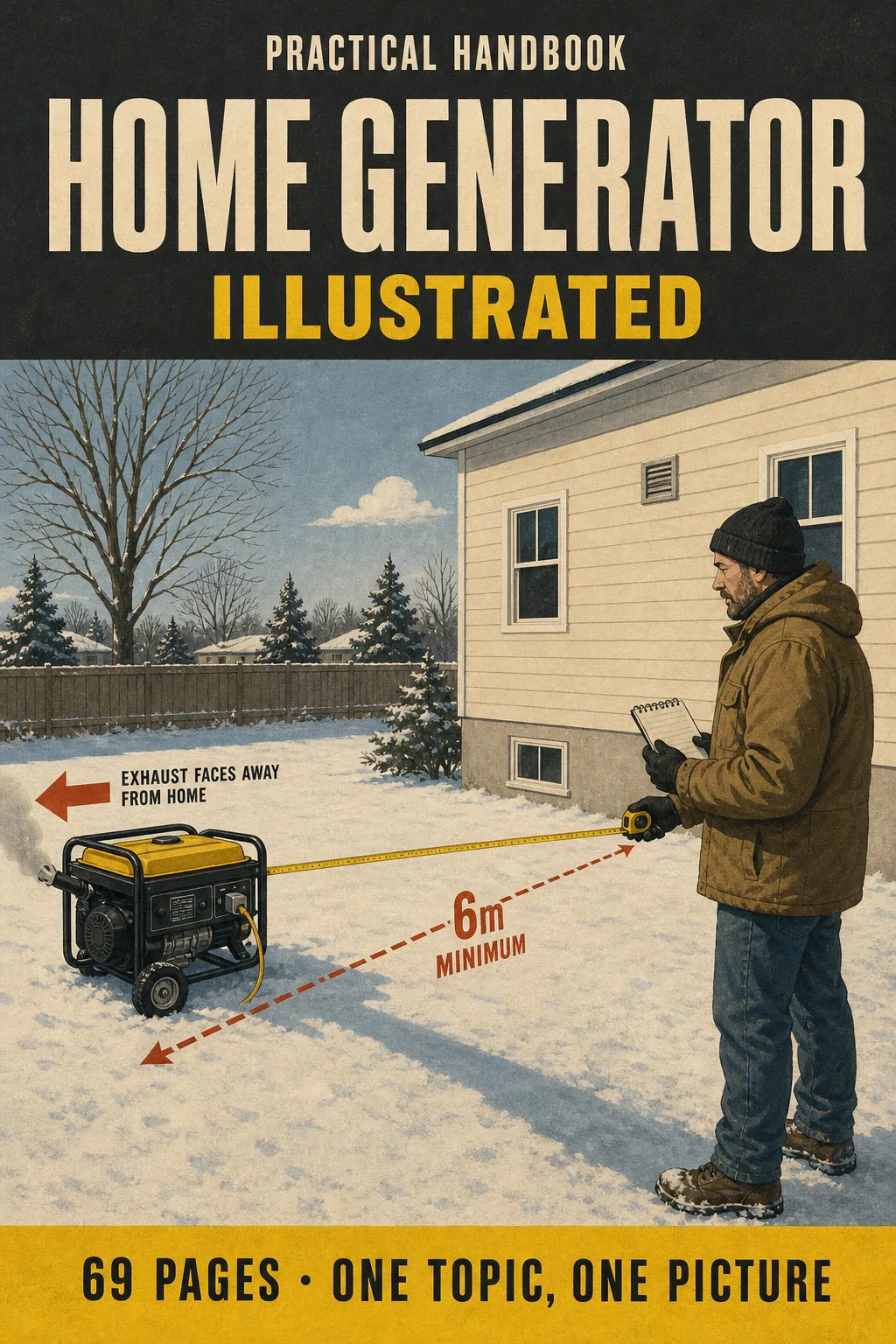
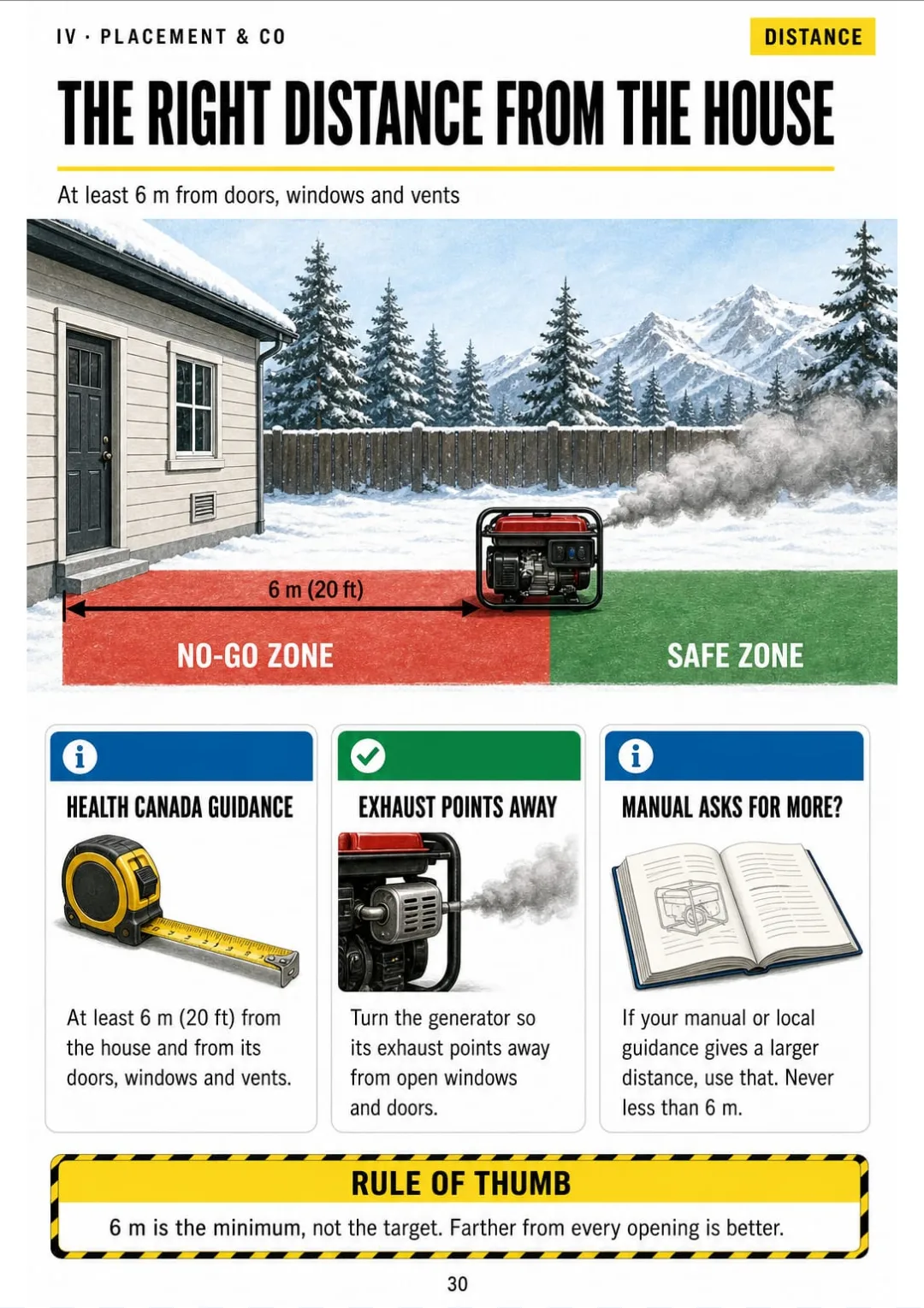
Health Canada: at least 6 m (20 ft) from the house, doors, windows and vents.
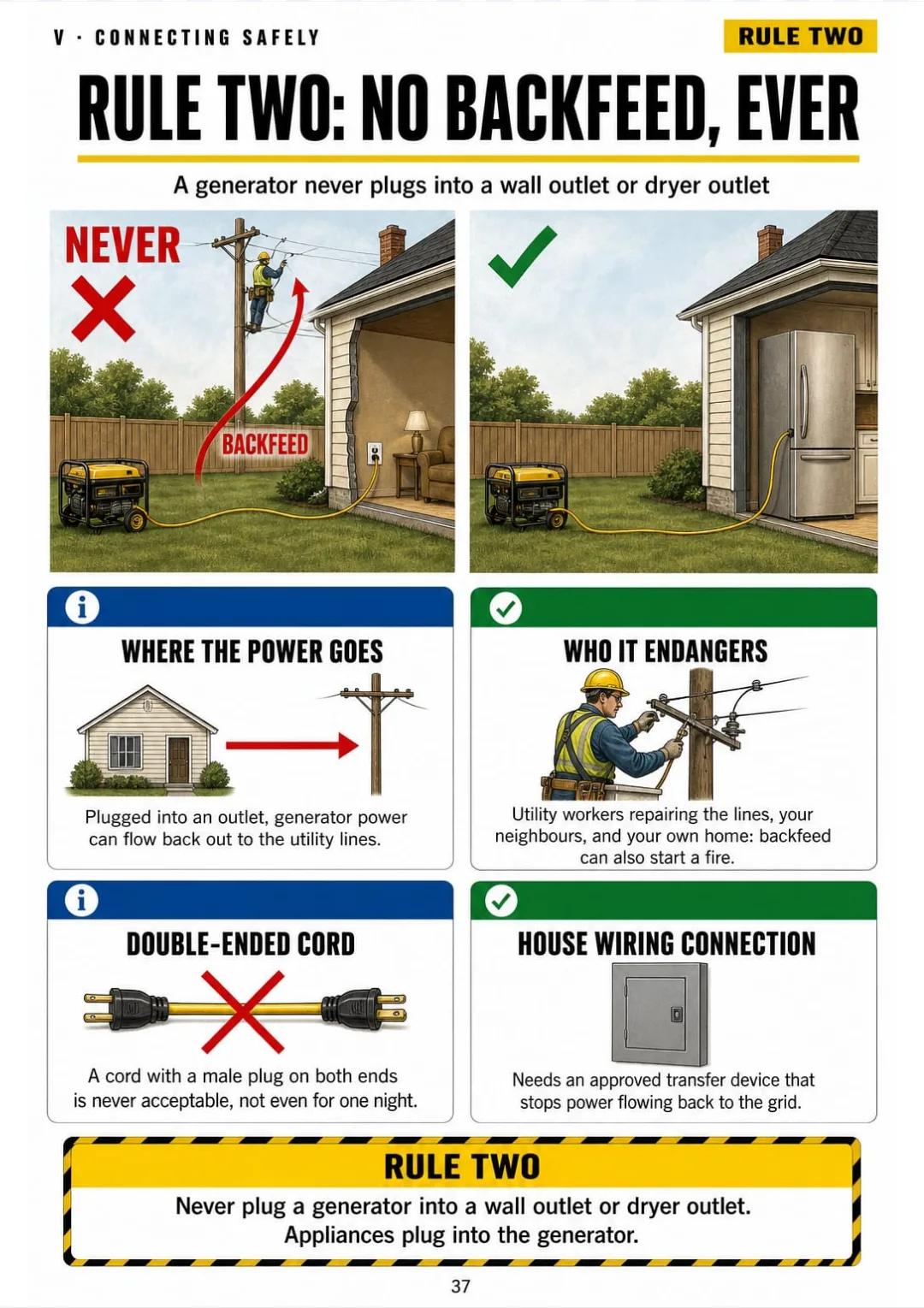
Backfeed: why a generator never goes into a wall outlet
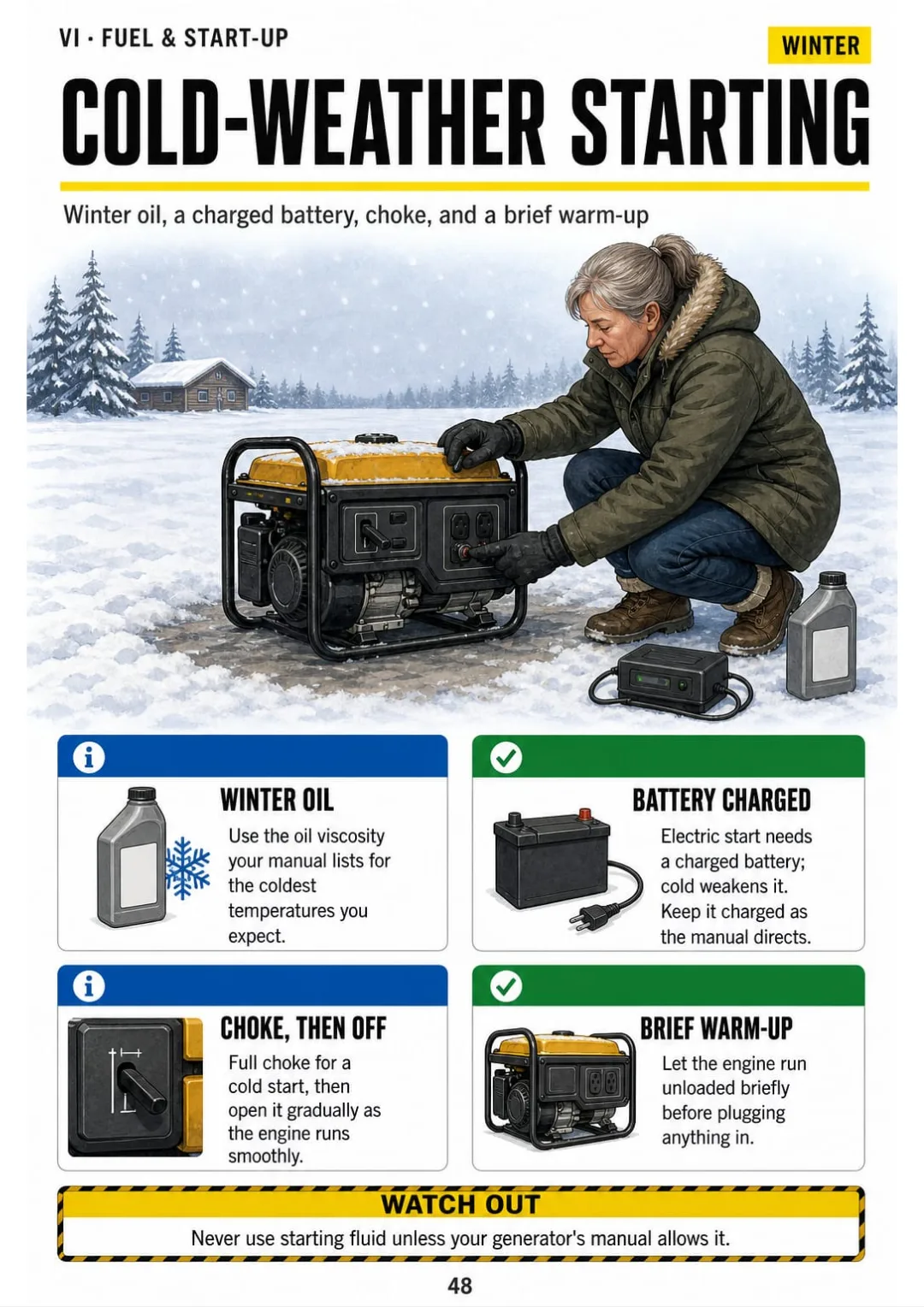
Manual's winter oil, charged battery, choke, brief warm-up; no starting fluid unless the manual allows it.
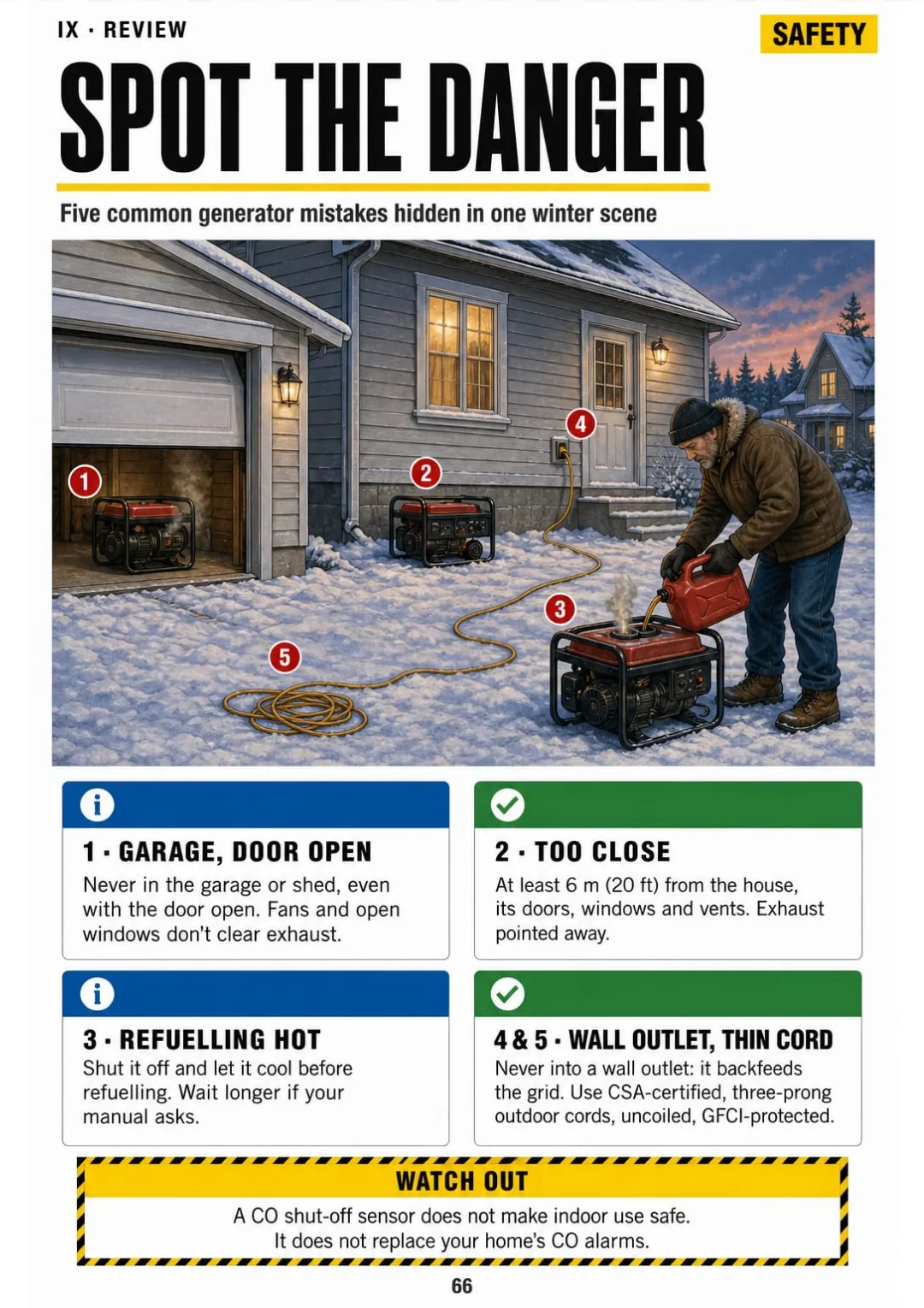
Garage, window, hot refuel, wall outlet, thin cord: five mistakes in one drawing.
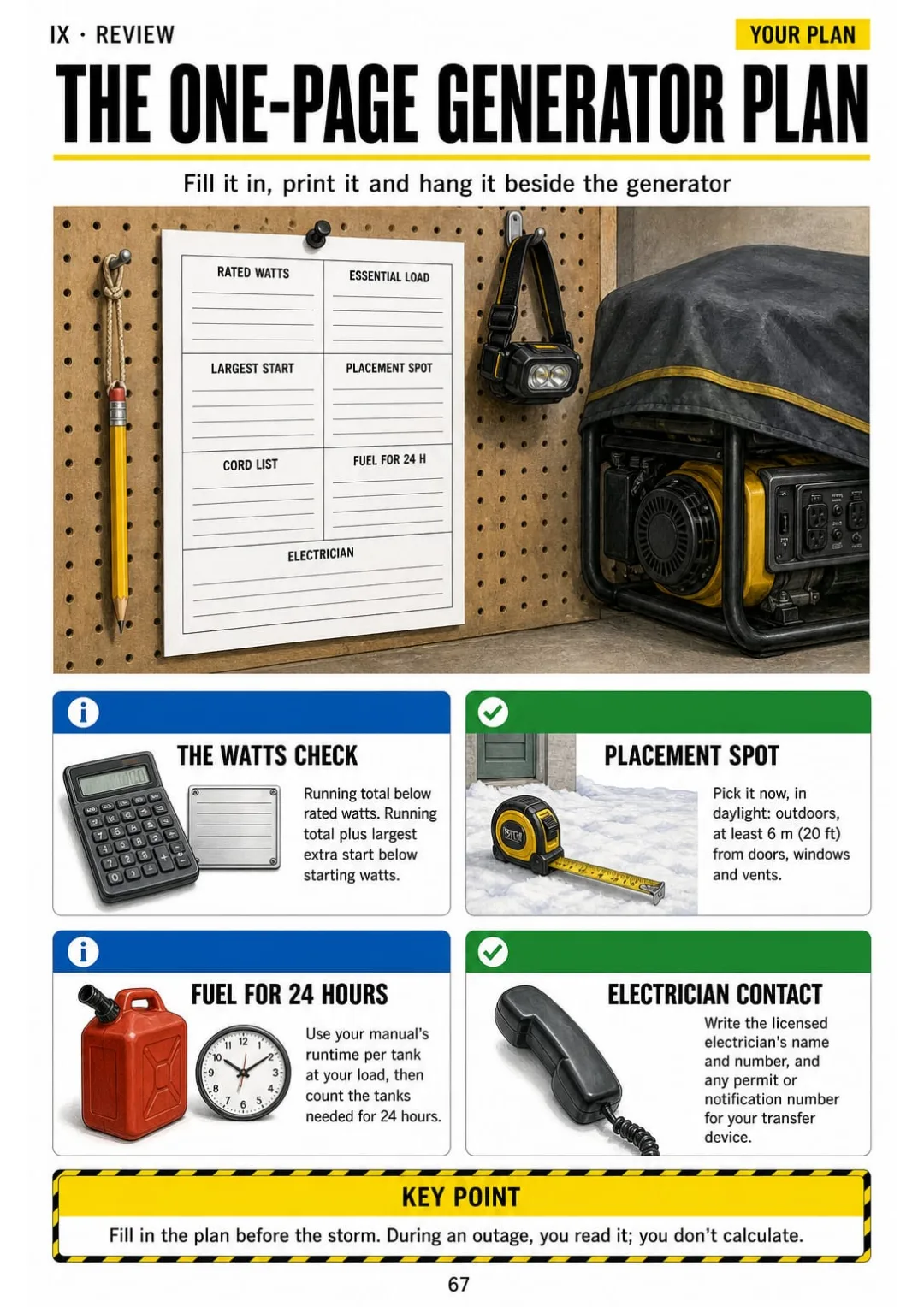
Seven boxes: rated watts, load, largest start, spot, cords, 24-hour fuel, electrician.

Swipe to see more →

These are real pages from the book. The table of contents is the full one: 9 parts and 65 topics.

The Problem Isn't You. It's How It Was Explained to You.

It's the first cold night of an outage. The generator is out on the driveway and you're looking at the fridge, the furnace fan and the well pump, wondering if it can carry all three at once.

The manual has the answer somewhere, in paragraphs about rated watts, surge watts and motor loads. Nobody adds it up for a real house like yours.

Rural house with well: 3,760 W running + 1,800 W pump start = 5,560 W starting watts needed.

In the book, that rural house with a well is one page: each load drawn with its running watts, added up to 3,760 W, then the extra 1,800 W the well pump needs for a few seconds to start. 5,560 W, worked out right in front of you.

The suburban house on town water, the sump pump, the gas furnace fan, the safety margin and staggering loads each get their own page too.

You add up your own list, see what your generator can carry and make the call without going back to the manual.

COMPARE FOR YOURSELF

The Same Topic, Two Ways to Learn It

THIS
  • The manual: lines and lines of text
  • Appliance watts explained only in words
  • You face the outage with doubts
The power requirement of a household appliance is expressed in running (rated) watts, representing continuous consumption under normal operating conditions, and in starting (surge) watts, representing the transient demand during motor start-up. Refrigerators typically draw between 350 and 800 watts in continuous operation, while compressor inrush current may momentarily require up to 2,400 watts. Values vary according to model, age, efficiency rating and ambient temperature; consequently, the nameplate data affixed to each appliance should be consulted prior to calculating total generator capacity.
FOR THIS
  • Each appliance in one drawing
  • The running and starting watts in a box
  • You see it and you get it
Fridge: about 350–800 W running, up to 2,400 W to start. Typical figures, check your labels.
CONTENTS

Take a Look at the 9 Parts and 65 Topics

How it works, your load list, choosing a generator, placement and carbon monoxide, connecting safely, fuel and start-up, the winter outage plan, maintenance and the final review: 69 pages, all illustrated.

IHow a Home Generator Works · pp. 5-11
  1. What a Generator Really Does in an Outage
  2. Portable, Inverter, Standby: The Three Families
  3. Volts, Amps and Watts on One Page
  4. 120 V and 240 V: Why Your Well Pump Matters
  5. Running Watts vs Starting Watts
  6. Reading the Generator's Data Plate
  7. Reading an Appliance Label
IIYour Load List: Sizing in Watts · pp. 12-21
  1. Essential vs Nice-to-Have Loads
  2. Typical Watts for Common Canadian Loads
  3. The Gas Furnace: Small Watts, Big Importance
  4. Well Pump and Pressure Tank
  5. Sump Pump: The Load That Can't Wait
  6. The Method: Add Running, Add One Largest Start
  7. Worked Example: A Rural House with a Well
  8. Worked Example: A Suburban House on Town Water
  9. The Safety Margin
  10. Staggering Loads Instead of Buying Bigger
IIIChoosing the Right Generator · pp. 22-28
  1. Gasoline, Propane or Dual-Fuel
  2. Natural Gas Standby: When It Makes Sense
  3. Inverter or Conventional Portable
  4. Electric Start, Cold Start and CO Shut-Off
  5. Outlets on the Panel: What Each One Is For
  6. Certification Marks and Where to Buy
  7. Noise, Runtime and Tank Size
IVPlacement and Carbon Monoxide · pp. 29-36
  1. Rule One: Never Indoors, Never the Garage
  2. The Right Distance from the House
  3. Furnace Intakes, HRV and Dryer Vents
  4. Wind, Snow and Wrong-Side Placement
  5. Rain and Snow Cover That Stays Safe
  6. Carbon Monoxide Alarms in the House
  7. Standby Unit Clearances
  8. Theft, Kids and Pets
VConnecting Safely · pp. 37-43
  1. Rule Two: No Backfeed, Ever
  2. Option 1: Extension Cords Directly to Appliances
  3. Choosing the Right Cord
  4. Option 2: Inlet Box and Interlock Kit
  5. Option 3: Manual or Automatic Transfer Switch
  6. Permits, Licensed Electricians and Inspection
  7. Grounding: Check Your Manual
VIFuel, Start-Up and Running · pp. 44-51
  1. Storing Gasoline the Safe Way
  2. Stale Gas: Why It Won't Start in January
  3. Propane Cylinders in the Cold
  4. The Start-Up Routine, Same Order Every Time
  5. Cold-Weather Starting
  6. The Refuelling Routine
  7. How Much Fuel for 24 Hours
  8. Shutting Down Without Damage
VIIThe Winter Outage Plan · pp. 52-57
  1. The First Hour of an Outage
  2. Keeping Pipes from Freezing
  3. A Day of Running: The Load Schedule
  4. Food Safety During an Outage
  5. A Three-Day Outage Checklist
  6. When the Power Comes Back
VIIIMaintenance and Cold Storage · pp. 58-64
  1. The Maintenance Calendar
  2. Changing the Oil
  3. Air Filter and Spark Plug
  4. The Monthly Test Run
  5. Battery Care for Electric Start
  6. Preparing for Storage and for Winter
  7. Standby Unit: Owner Checks
IXReview: Checklists and Frequent Mistakes · pp. 65-69
  1. Frequent Sizing Mistakes
  2. Frequent Safety Mistakes
  3. The One-Page Generator Plan
  4. Pre-Storm Checklist
  5. Check Against Your Manual and Canadian Code

One Page, One Topic, All Clear

Think of it this way:

Freezing rain has brought the lines down, it's dark by five and the sump pit is filling. You need the generator running, and running right, tonight.

You open the start-up page: placed outdoors, oil checked, fuel in, nothing plugged in, choke and start, a few minutes to warm up, then loads on largest first. The same order, every time.

Backfeed: why a generator never goes into a wall outlet

Same with the distance from the house, the refuelling routine, choosing the cord, fuel for 24 hours and the monthly test run: each one on its own page.

Home Generator Illustrated is 9 parts and 65 topics, all drawn, ending with the frequent mistakes, a pre-storm checklist and a one-page generator plan to fill in.

What you see drawn, you don't have to memorize.

What's Inside Home Generator Illustrated:

Ipp. 5-11

How a Home Generator Works

What a generator really does, portable vs inverter vs standby, volts, amps and watts, 120 V and 240 V, running vs starting watts and how to read the labels.

IIpp. 12-21

Your Load List: Sizing in Watts

Essential vs nice-to-have loads, typical watts, the gas furnace, well pump and sump pump, the sizing method, two worked houses, the safety margin and staggering loads. You finish knowing exactly what your generator can carry.

IIIpp. 22-28

Choosing the Right Generator

Gasoline, propane or dual-fuel, natural gas standby, inverter or conventional, cold start and CO shut-off, the outlet panel, certification marks, noise and runtime.

IVpp. 29-36

Placement and Carbon Monoxide

Never indoors or in the garage, the distance from the house, furnace intakes and vents, wind and snow, safe covers, CO alarms, standby clearances, theft, kids and pets. You know where it goes before the storm, not during it.

Vpp. 37-43

Connecting Safely

No backfeed, ever, cords straight to appliances, choosing the cord, inlet box and interlock, transfer switches, permits and licensed electricians, grounding.

VIpp. 44-51

Fuel, Start-Up and Running

Storing gasoline, stale gas, propane cylinders in the cold, the start-up routine, cold-weather starting, refuelling, fuel for 24 hours and shutting down.

VIIpp. 52-57

The Winter Outage Plan

The first hour of an outage, keeping pipes from freezing, a day's load schedule, food safety, a three-day checklist and when the power comes back.

VIIIpp. 58-64

Maintenance and Cold Storage

The maintenance calendar, oil changes, air filter and spark plug, the monthly test run, battery care, winter storage and standby owner checks.

IXpp. 65-69

Review: Checklists and Frequent Mistakes

Frequent sizing and safety mistakes, the one-page generator plan, the pre-storm checklist and what to check against your manual and Canadian code.

At the end of the book: A spot-the-danger drawing, the frequent mistakes, a pre-storm checklist and a one-page generator plan to fill in.
Plus: 2 Free Books

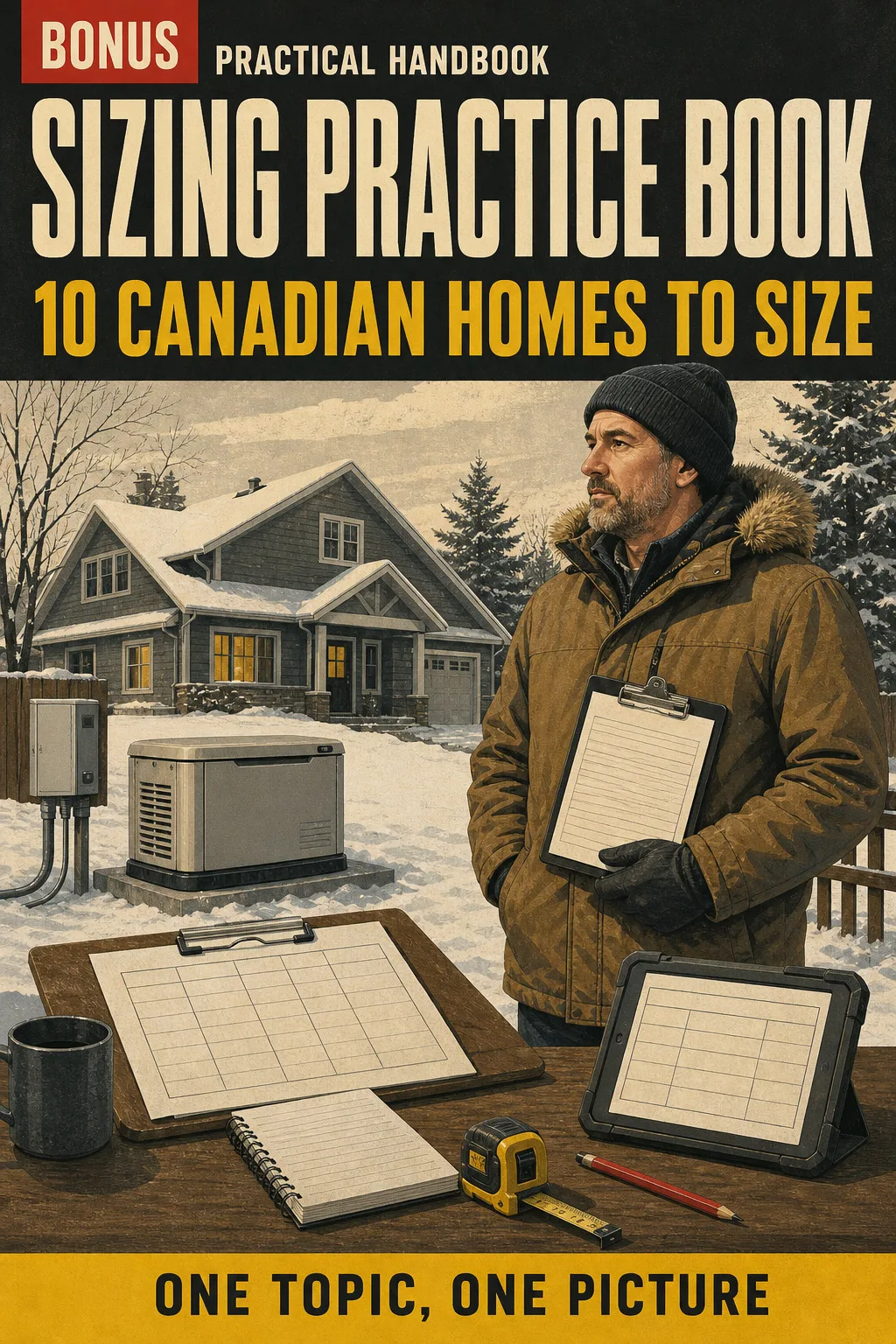
Sizing Practice Book: 10 Canadian Homes to Size

BONUS 1: «Sizing Practice Book: 10 Canadian Homes to Size»

Value on its own: US$ 17.90

Practise adding up running and starting watts on 10 real-life houses (with a well, a sump pump, a gas furnace) until sizing your own takes one page and five minutes.

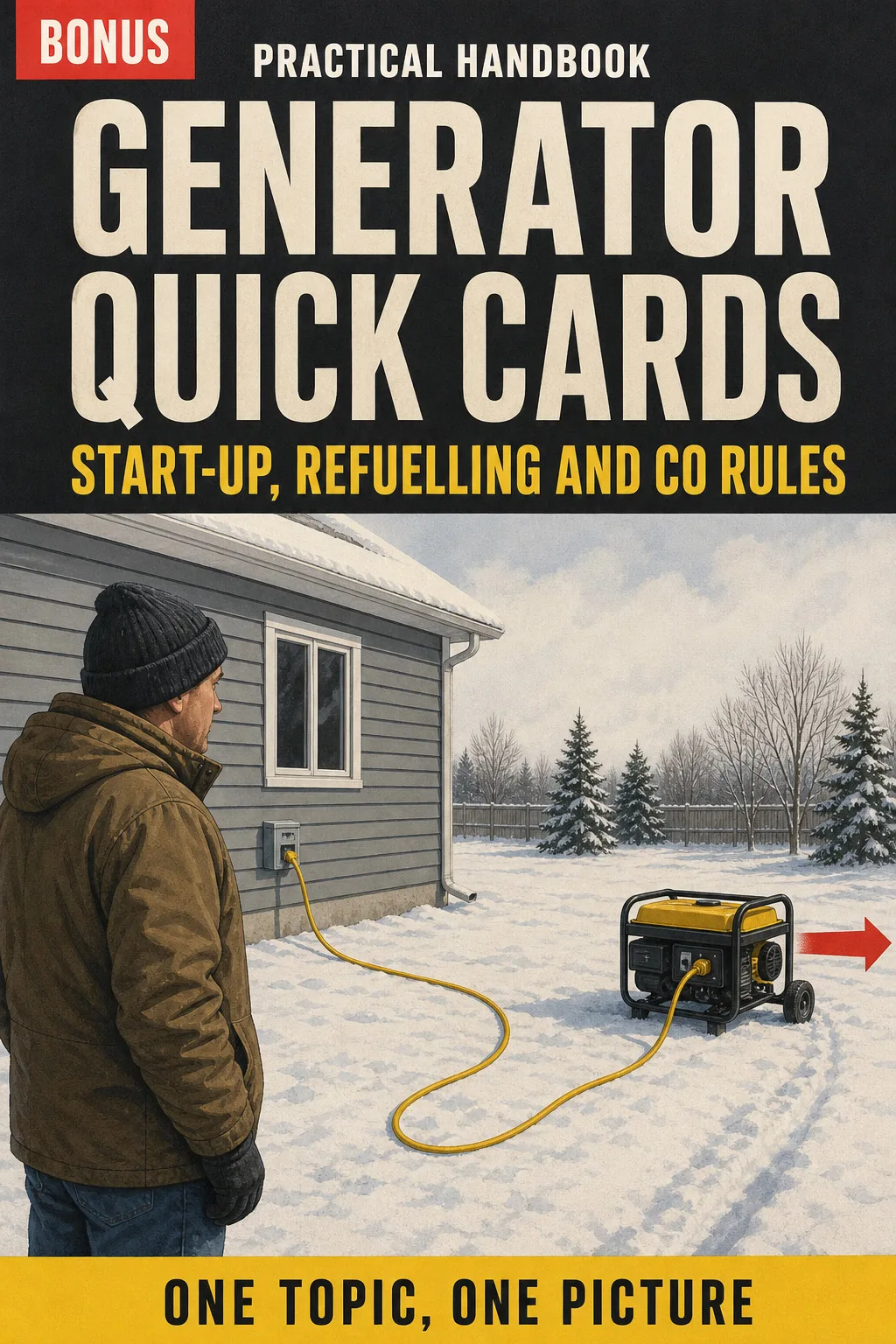
Generator Quick Cards: Start-Up, Refuelling and CO Rules

BONUS 2: «Generator Quick Cards: Start-Up, Refuelling and CO Rules»

Value on its own: US$ 14.90

Printable cards to keep next to the generator, so in a dark, cold outage you follow the same steps without opening the book.

Home Generator Illustrated with 2 Free Books

  • Home Generator Illustrated: 69 illustrated pagesUS$ 63
  • BONUS 1: Sizing Practice Book: 10 Canadian Homes to SizeUS$ 17.90
  • BONUS 2: Generator Quick Cards: Start-Up, Refuelling and CO RulesUS$ 14.90
  • High-resolution PDF to printIncluded
Total value US$ 95.80
YOUR PRICE:
US$ 27
You save US$ 68.80
YES, I WANT HOME GENERATOR ILLUSTRATED FOR US$ 27

📄 This is a digital PDF book sent to your email: nothing is printed or shipped.

Secure purchaseEncrypted payment30-day guarantee

PDF by email: We email you Home Generator Illustrated as a PDF, together with the two free books. It's a single payment: no installments, no extra charges.

Who This Book Is For

You're about to buy one

You're about to buy one

You see why it's sized by your load list and not by the biggest number on the box, and you choose portable, inverter or standby with the watts in front of you.

A storm is in the forecast

A storm is in the forecast

Start-up, refuelling and the distance from the house on one page each, plus the pre-storm checklist, so the first night of the outage isn't guesswork.

It's already in the garage

It's already in the garage

The maintenance calendar, the monthly test run and winter storage, so it starts in January. And the backfeed page, to settle the 'just plug it into the dryer outlet' talk for good.

Everything You Get Today

US$ 95.80US$ 27
YES, I WANT HOME GENERATOR ILLUSTRATED FOR US$ 27

📄 This is a digital PDF book sent to your email: nothing is printed or shipped.

30DAYS
GUARANTEE

30-Day Guarantee

Try Home Generator Illustrated for 30 days, bonus books included.

We refund everything if the file won't open, if the book isn't what you see here, if you were charged twice or if the email doesn't arrive. Just email us.

You pay once. No subscriptions.

Frequently Asked Questions

Is it for me if I'm not an electrician and my generator is still in the box?

Yes. It's written for Canadian homeowners with a portable, inverter, standby or dual-fuel unit, in metric and with our winters in mind: cold starts, snow and wind, frozen pipes, propane in the cold. It starts from what a generator does in an outage and never asks you to wire anything. For the exact figures of your model, it always sends you back to the label and your owner's manual.

Where does the content come from?

From the Canadian Electrical Code, the natural gas and propane installation code, Health Canada's carbon monoxide guidance, provincial electrical safety authorities and manufacturers' owner's manuals. Every figure and interval is marked to check against your own manual.

Is it official material?

No. It's an independent illustrated book. It isn't published, approved or endorsed by any organization, safety authority or generator brand.

Does it replace my owner's manual or an electrician?

No. Your manual rules for your model: what it can carry and how to service it. The book does what the manual doesn't: it adds up the loads of a real house, shows placement, CO and start-up as drawings, and plans the winter outage. Any connection to your panel (inlet box, interlock, transfer switch) is a job for a licensed electrician, with a permit and inspection. The book says so plainly.

Are the practice homes official cases or test questions?

No. The 10 houses in the practice book are written for this book, with typical figures. For your own house, use the watts on your appliance labels.

When and how do I get it?

The book and the 2 bonus books arrive as a PDF by email, at the address you enter at checkout.

Do I have to pay every month?

No. It's a one-time payment.

Can I have it on paper?

It's a PDF, not a printed book: nothing is shipped to you. You can print it at home or at a print shop, and the quick cards are made to keep in the garage, next to the generator.

How does the refund work?

You have 30 days. We refund everything if the file won't open, if the book isn't what you see on this page, if you were charged twice or if the email doesn't arrive: just email us.

Before You Close This Page

No more rereading the manual without it sticking.

Your load list, you see it drawn and added up.

You reach the next outage knowing where everything goes.

Drawings make studying faster.

The book is right below.

One-time payment: US$ 27 · Guarantee: 30 days · PDF by email

YES, I WANT HOME GENERATOR ILLUSTRATED FOR US$ 27

📄 This is a digital PDF book sent to your email: nothing is printed or shipped.